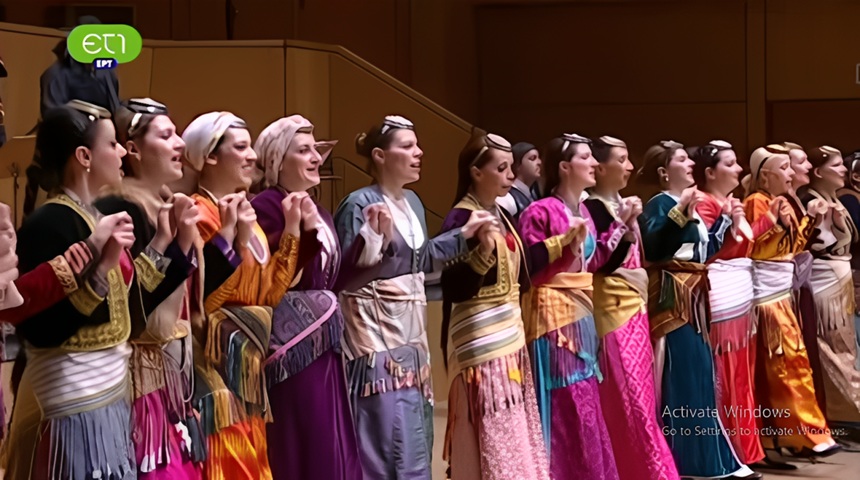
Various Pontic Greek zipouna dresses
Sam Topalidis (2026)
(Pontic Historian and Ethnologist)
The reported history and culture of Pontos in the north-east of Anatolia near the Black Sea (Fig. 1) has produced some speculation and inaccurate information. This document identifies some gaps in our information on Pontos which may be impossible to resolve. Some of these gaps in our knowledge are identified in the following chronological order:
1. Before 1200 BC, did the Mycenaean Greeks trade in Pontos and in the wider Black Sea? If so, when and where? Is this where the legend of Jason and the Argonauts originated?
To resolve these questions, more archaeological investigation is needed in the Black Sea coastal area and at the bottom of the Black Sea for possible Greek shipwrecks.
2. When did Greeks actually first colonise Pontos?
Again, this may be resolved with more archaeological investigation. This investigation is hampered by Turkish settlements on the Black Sea coast which are covered with bitumen and concrete etc. Maybe in the future they will develop an underground railway system in Samsun and Trabzon and a treasure of historic items may be unearthed.
Currently, archaeological evidence does not prove that there was any Greek settlement on the southern Black Sea coast before the last third of the 7th century BC (i.e. at Sinope).
3. What was the proportion of local natives to Greeks in Miletos (on the west coast of Anatolia) at the time they sent out colonies to Pontos? Were the colonists from Miletos only Greeks?
This will support the notion that Greeks were not the only colonists who settled in early Miletos, Sinope, Amisos (Samsun), Kotyora (Ordu), Kerasous (Giresun) and Trabzon etc. (Fig. 1).
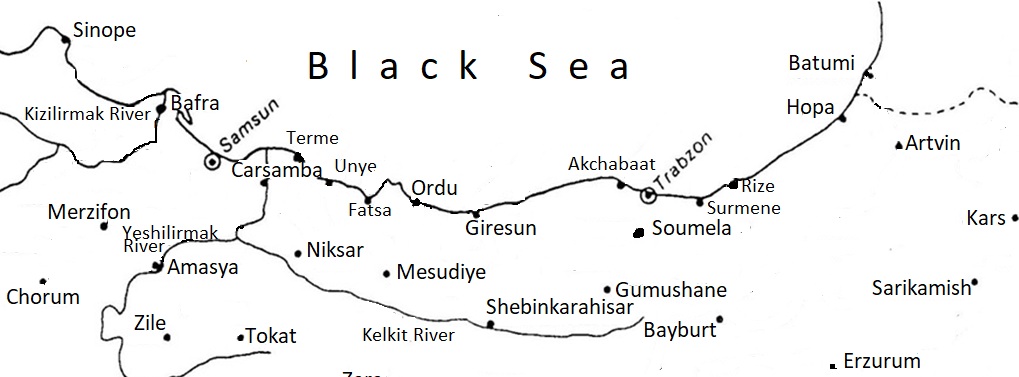
Fig. 1: North-eastern Anatolia (290 km Samsun to Trabzon)
4. In 400 BC, Greek General Xenophon and his Greek mercenaries travelled through much of Pontos. How large were the Greek settlements they visited like Trabzon, Giresun, Ordu and Sinope?
- Sinope must have been the largest Greek colony.
5. When was Tonya (70 km south-west of Trabzon) founded? Was it first settled by Greeks, if so, when? When did the local Christian Greeks convert to Islam and why?
Nothing is known of the foundation of Tonya—it is a mystery. Maybe Greeks settled Tonya over 2,000 years ago. The Greeks there spoke Romeyka.[ In the 11th century, when the Seljuk Turks invaded Anatolia, the Greek language in Pontos became more isolated from other Greek speaking areas. The isolation of Pontos would explain the preservation of many medieval characteristics in Romeyka in Türkiye and the Pontic Greek spoken in Greece that has disappeared elsewhere (e.g. in demotic Greek) (Mackridge 1987).] Today, some Muslims (whose ancestors probably converted to Islam from the late 15th century) who live around Tonya still speak Romeyka. Cambridge Professor, Ioanna Sitaridou, has recently conducted field work on Romeyka in Tonya. We await her published work.
6. Where are the skeletal remains, that could possibly be Saint Eugenios,[ Eugenios and other martyrs were believed to have been put to death during the reign of Roman emperor Diocletian (285–305) after overthrowing the statue of Mithras on Boztepe at Trabzon. ] that were found in 1916 in the former St Eugenios Church in Trabzon? If found, could DNA analysis of the skeleton be conducted to determine their age?
The location of the possible remains of Saint Eugenios is probably somewhere in Russia. So, if these bones were found and DNA analysis were possible to determine their age (i.e. around 300 AD), it would help to support or outright refute they were Eugenios’ remains. DNA analysis may be useful to study the history of the individual.
7. Who actually built the Panagia Soumela Orthodox Monastery, south of Trabzon (Fig. 1, Plate 1) and when?
It is difficult to separate tradition from fact in the early history of Soumela. It was built by the 10th century at least. Accurate information would be invaluable in understanding the development of Christianity around Trabzon. The monastery was rebuilt in 1360–1365 (Bryer and Winfield 1985:254).
8. What is the history of the revered Panagia Soumela icon (Plate 2) now located in the new Soumela Monastery in Kastania, south of Veria, in northern Greece?
The painted wooden panel of the icon from the Soumela Orthodox Monastery, near Maçka, south of Trabzon, was made first. The predominantly gold covering of the wooden panel was added, possibly much later. Because the silver mines (which also produced some gold) around Gümüşhane (south of the Soumela Monastery) did not develop until after 1590, the gold covering ‘may’ have occurred sometime after this date.
Carbon dating of the wooden panel (if ever conducted) would determine its age. By comparing trace elements in a gold sample, experts may be able to determine the gold source on the icon. Studying the age of the Greek script on the gold covering ‘may’ also help to identify the age of the gold covering.
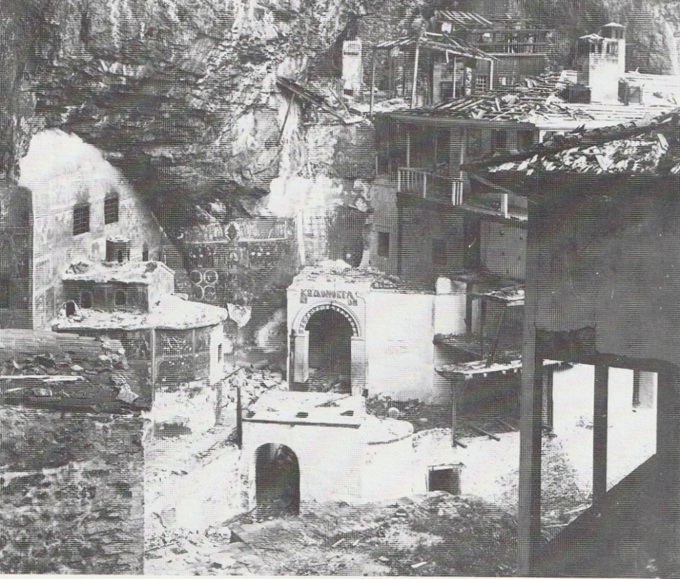 Plate. 1: Damaged courtyard in the Soumela Monastery 1929 (Bryer and Winfield 1985, plate 209)
9. Will a DNA analysis of the skeleton of what is believed to be Trebizond emperor Alexios IV Komnenos (who died in 1429) at the new Soumela Monastery south of Veria, in northern Greece, ever occur?
If viable DNA can be extracted, analysis will determine the age of the skeleton which can support or absolutely refute they are the remains of Alexios IV. These believed remains are the only known remains of a Byzantine emperor. DNA analysis will also be useful to study the history of the individual.
10. The Greek dialect of Romeyka was spoken by Greeks (and some Muslims) over Pontos. Which exact areas did Greeks not speak Romeyka and why?
Some Pontic Greeks only spoke Turkish, like in Tokat, Terme and some areas around Samsun (in western Pontos). Presumably, for a period, they spoke Romeyka in private.
11. What are the locations of the silver, copper and other mines around the greater Gümüşhane area south of Trabzon from the 1600s? What metals and how much were extracted and how many miners and smelters etc. worked there?
Details on all mines around the greater Gümüşhane area are lacking. It will involve considerable research in the Ottoman archives, assuming access is given and researchers can read Turkish written in the Arabic script.
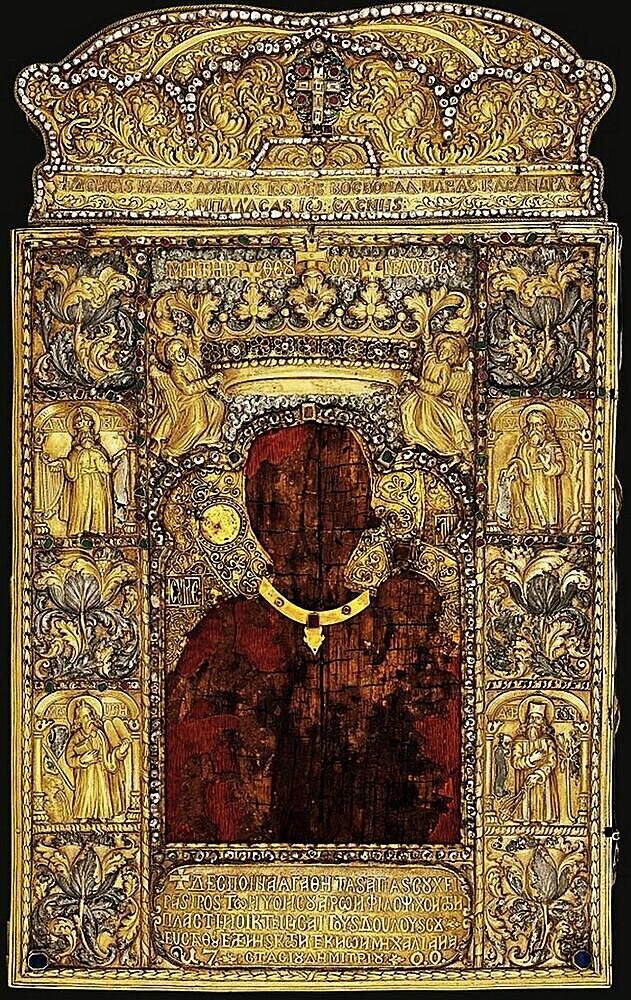
Plate 2: The Panagia Soumela icon (twitter.com/TempusFugit4016/status/1714476808710570456)
12. In 1719, the Vazelon Orthodox Monastery, south of Trabzon, was robbed by Turks who stripped it of most of its famous archive. Do any of these valuable books survive?
The lost texts would be an invaluable source of history.
13. When did the shape of the current three string kemenche musical instrument (Plate 3) develop? What is the kemenche’s real origin?
Knowledgeable people debate that the current kemenche (also called Pontic lyra) could be Byzantine or Asian in origin. Was the current design older than the mid-19th century?

Plate 3: Kemenche by Terry Topalidis[ Terry is the brother of the author. ] (Hellenic Club of Canberra)
14. When were the versions of the Pontic Greek serra dance performed by men first choreographed?
There is a myth that this spectacular dance has ancient Greek roots, which has no basis in fact. Was serra choreographed as recently as the late 19th century? The Pontic Turk serra differs from the Pontic Greek versions. Pontic Armenians probably also danced their version of serra.
15. What is the history of the small round head ornament tapla (Plate 4), part of the traditional costume worn by many Pontic Greek women? Is the origin of the tapla older than the mid-19th century?
The tapla does not seem to have a Byzantine root, or does it? The author is unsure if Pontic Turk women wore the tapla? It was however worn by Pontic Armenian women.

Plate. 4: Tapla head ornament (folkcostume.blogspot.com/2021/02/costume-of-city-of-trabizond-and.html)
16. What were the reasons for the different colours and patterns of the zipouna dresses (Plate 5) and the aprons (Plate 4) that Greek women wore in the different areas of Pontos? Did they have to be different from what the Muslim women wore (if they lived in the same village etc.)?
Bryer (1979:388) hypothesised that the local striped cloths of Pontos in the 19th century probably had a much older design. Each major settlement favoured a slightly different stripe, although whether this was because of local whim and availability, or represents an older notion of tartan, is hard to know.
Plate 5: Various Pontic Greek zipouna dresses (folkcostume.blogspot.com/2021/02/costume-of-city-of-trabizond-and.html)
17. During World War I, what Greek and Ottoman items did the Russians remove from Trabzon and its environs during their occupation? In particular, what did Russian Professor Uspenskii’s archaeological teams take out of Trabzon?
The Turkish Government requested from Russia the historical artefacts that were smuggled out of Trabzon during World War I (1916–early 1918). It has been alleged that among these works were 497 Qurans, candlesticks from the Gülbahar Hatun Mosque, the covering on the Gülbahar Hatun Tomb and items from churches. It was also alleged that between 32 and 48 tonnes of books, manuscripts and papers were removed. Most of these seized books and manuscripts were returned to Turkey.
In 2014, Recep Tayyip Erdogan, during his Prime Ministry, asked Vladimir Putin to return the remaining artefacts removed by the Russians. A delegation of historians was established between the two countries to investigate this issue. Sadly nothing has resulted.
18. Who were the armed bandits around Trabzon who were stealing goods and murdering people during the Russian occupation (1916–early 1918)?
Some of these bandits were Armenian, some Turks, some were probably part of the Russian military. Could they have included Greeks?
19. How many Pontic Greeks actually died as part of the Genocide in Pontos by the Young Turks (in World War I) and the Kemalists?
We will never know the exact number. The estimate by some Greek sources which is often blindly repeated is an exaggeration.
20. How many Pontic Greeks who lived in the Russian empire and the Soviet Union, prior to and after World War I? How many of them were born in Pontos? How many (who were not born in Pontos) had one or both parents who were born in Pontos?
The population censuses in the Russian empire and the Soviet Union under-reported Greeks. Knowing how many of these Greeks who were born in Pontos or were children of one or both parents who came from Pontos is valuable in determining the real number of Pontic Greeks. If we accept that the population data on Greeks in Anatolia prior to World War I by the Ecumenical Patriarch of Constantinople is reasonable (as recorded in Alexandris (1999)), there were at least 410,000 Greeks in Pontos (Topalidis 2019; 2024).
21. How many Greeks were born in Pontos, or had one or both parents who were Pontic Greeks arrived in the diaspora?[ For the record, the author’s father was born in Pontos and the author’s mother’s parents and her three older brothers were also born in Pontos. ]
It is very difficult to get an accurate number of people of Pontic Greek descent in the diaspora.
Conclusion
There are many things we need to know to improve our understanding of Pontic history and culture. We need to find new Russian and Turkish sources. Many of the aspects discussed here may only be resolved (if ever) with great difficulty. Like much in life, we may never know the answer to these questions, but nevertheless we carry on with the best available information.
Acknowledgements
I am grateful for the discussion with some Pontic Greek researchers from Greece. I also thank Russell McCaskie for his suggestions.
References
Alexandris A (1999) ‘The Greek census of Anatolia and Thrace (1910–1912): a contribution to Ottoman historical demography’, in Gondicas D and Issawi C (eds) (1999), Ottoman Greeks in the age of nationalism,: 45–76, The Darwin Press Inc., New Jersey, USA.
Bryer A (1979) ‘The estates of the empire of Trebizond’, Twelfth Spring Symposium of Byzantine Studies: The Byzantine Black Sea, Birmingham, 18–20 March 1978, Archeion Pontou [Archives of Pontos], 35:370–477.
Bryer A and Winfield D (1985) The Byzantine monuments and topography of the Pontos, I–II, Dumbarton Oaks Research Library & Collection, Harvard University, Washington DC, USA.
Mackridge P (1987) ‘Greek-speaking moslems of north-east Turkey: prolegomena to a study of the Ophitic sub-dialect of Pontic’, Byzantine and Modern Greek Studies, 11:115–137.
Topalidis S (2019) History and culture of Greeks from Pontos Black Sea, Afoi Kyriakidi Editions SA, Thessaloniki, Greece.
Topalidis S (2024) Greek Pontos, Afoi Kyriakidi Editions SA, Thessaloniki, Greece.